
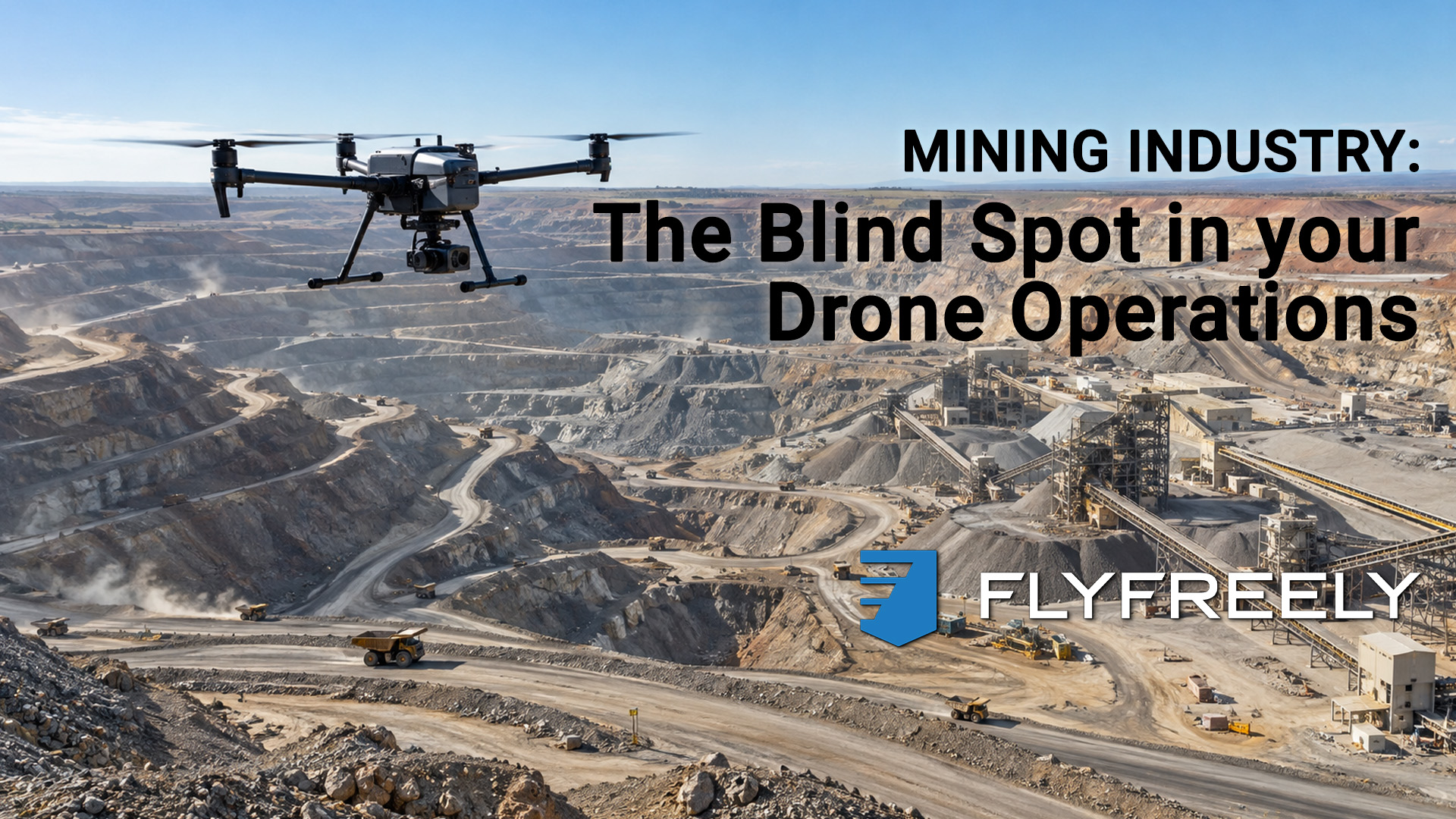
The Blind Spot That's Costing Mining Operations More Than They Know
Published by
Gayle Godkin
on
Right now, on at least one of your sites, something is happening that you can't see. Not because anyone's hiding it — because nobody built a way for you to see it. A contractor is in the air over ground you're responsible for. An inspection is being flown by someone whose training you couldn't verify without a phone call and a wait. A piece of equipment that's overdue for maintenance is still in active use, and the person who'd know that isn't the person who'd think to tell you.
The blind spot isn't a risk you're managing. It's a risk you can't see, which is worse.
That gap — between what's actually happening across your operation and what you can actually see and prove — is the blind spot. It doesn't announce itself. It just sits there, quietly, until something forces it into view.
Where the Blind Spot Comes From
It starts small and reasonably. A surveyor speeds up a stockpile check. A geotech tech looks at a pit wall without scheduling a scaler. An environmental officer monitors rehab from the air instead of walking it. Every one of these proves real value, fast, at one site, by someone motivated to make it work. Leadership sees that and says: do this everywhere.
What one good site proves, thirty sites without a shared view will quietly hide from you.
That's the exact moment the blind spot opens up. What worked as one person's good instinct at one site doesn't survive being scaled across thirty sites, a mixed fleet, and a rotating cast of contractors — not because the work stops being valuable, but because nobody built the thing that would let anyone see the whole picture at once. You still get the stockpile checks, the pit wall inspections, the rehab monitoring. You just lose the ability to say, with confidence, who's doing them, where, and under what standard, on any given day, across the operation you're actually responsible for.
The Part of the Blind Spot That Isn't Even Yours to Watch
Contractors may sometimes make the blind spot worse, not better. Aerial survey crews, spraying operators, specialist inspectors — mining operations bring them in constantly, often operating under their own certificate rather than yours. That feels like it moves the risk off your plate. It doesn't move the blind spot at all — if anything, it deepens it, because now the thing you can't see is happening under someone else's paperwork, on your ground.
A blind spot you don't own is still a blind spot you're liable for.
If a contracted aircraft is in the air near a blast, over a tailings facility, or anywhere your own safety management system would normally apply, that activity happened on your lease, whether or not you had visibility into it. Insurers already understand this distinction, even where mining operations haven't caught up to it. A site that can produce a contractor's flight record and currency in minutes is a fundamentally different risk than a site where that same question triggers a search — and insurers price that difference directly.
What Gets Priced When You Can't See Clearly
BARS accreditation for crewed aviation in mining exists for exactly one reason: insurers and regulators stopped accepting "we're confident our operation is safe" as something they could actually price. They wanted the blind spot closed — proof, structured the same way, across every site, available on demand.
Drone operations are heading toward that same expectation, and most mining operations are still standing exactly where crewed aviation stood before BARS existed: confident, but unable to prove it quickly.
You can be genuinely safe and still get priced like you're not, if nobody can prove it fast enough to matter.
Not because the flying is unsafe. Because the proof — who flew, where, under what training, in what condition — lives scattered across spreadsheets, site-level habits, and institutional memory that doesn't survive being asked for on short notice. That's the blind spot showing up in the one place that actually costs real money: what an insurer is willing to charge you for a risk they can't see clearly either.
Closing the Blind Spot
None of this means flying less, or trusting your teams and contractors less. It means building the one thing most operations never get around to: a single, shared view across every site, every pilot, and every contractor, so the value already being created on the ground doesn't sit behind a gap nobody's watching.
That's the specific problem FlyFreely was built to solve — one system of record across every pit, every site, and every contractor, so the question "what's actually happening across our operation right now" has a real answer, in minutes, instead of a phone call and a wait.
If you can't currently answer that question with confidence, visit FlyFreely and see what closing that blind spot actually looks like — before it closes the gap for you, on its own terms, during an incident instead of a quiet Tuesday.